- You have no items in your shopping cart
- Subtotal: ৳ 0.00
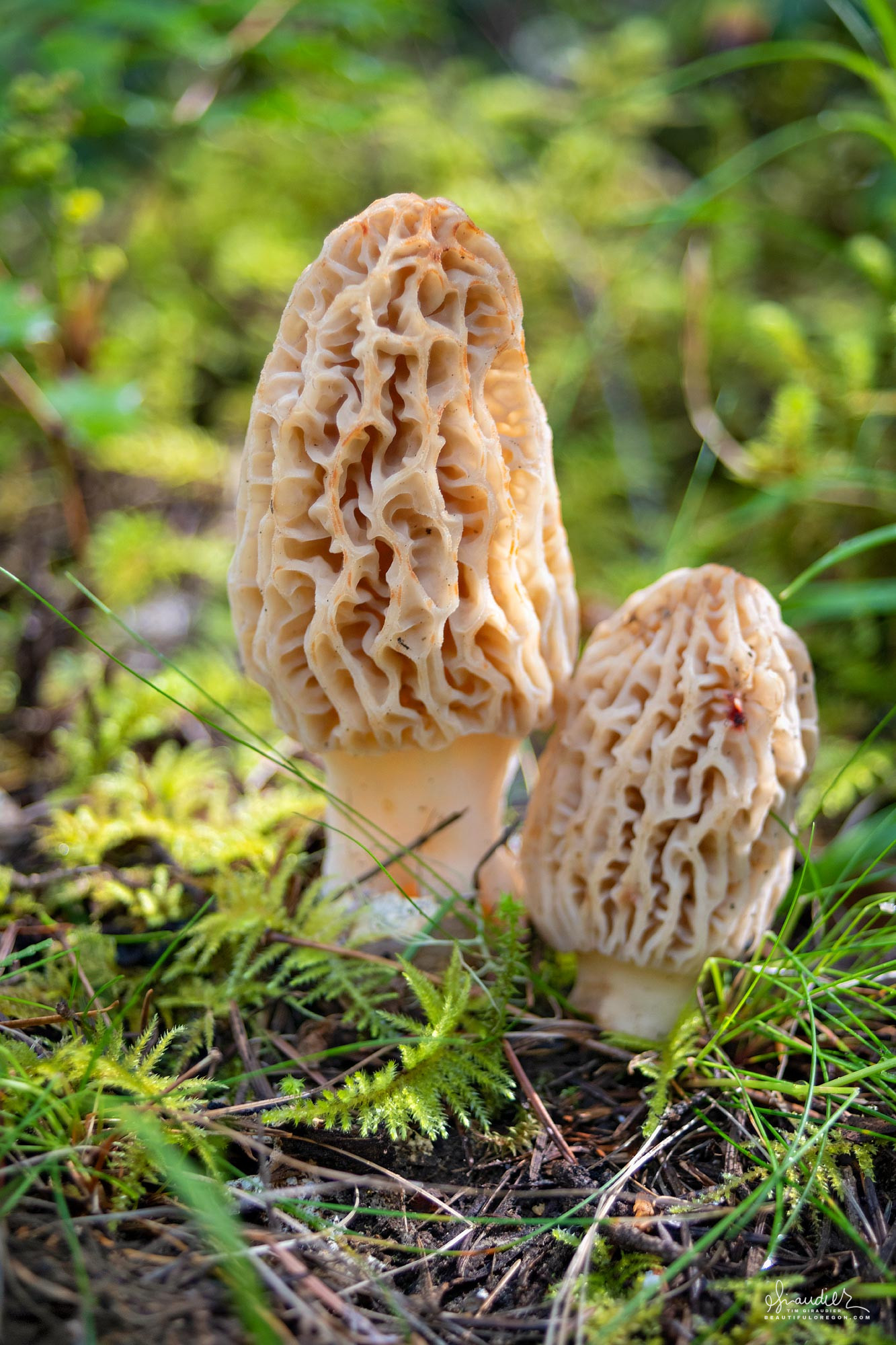

American Blonde Morel (Morchella americana) growing in a riparian forest of Black Cottonwood trees. Willamette National Forest, Oregon West Cascades. If interested in greeting cards of this image, you can find it in my Notecard Gallery here. Morchella americana – The American Blonde Morel Morchella americana, known commonly as the American Blonde Morel, is a pale yellow to tan edible mushroom found in spring forests throughout Oregon and the greater Pacific Northwest. With its distinctive honeycomb-patterned cap and hollow white stem, it stands out both visually and ecologically as one of the region’s most recognizable fungi. Its cap typically ranges from 5 to 15 centimeters in height and is shaped conically or ovoid, with a network of ridges and pits that define the genus Morchella. This species is primarily saprotrophic, meaning it decomposes organic material in the forest floor, playing a critical role in nutrient cycling. However, it may also engage in opportunistic relationships with the roots of certain hardwood trees, particularly ash (Fraxinus spp.) and oak (Quercus spp.), and in some cases conifers such as Douglas-fir (Pseudotsuga menziesii). These associations are not well understood but suggest a flexible life strategy, capable of shifting between ecological roles depending on environmental conditions. Morchella americana is also considered a pyrophilous species—one that thrives in post-fire environments. Following wildfire, when competition from other soil fungi is reduced and mineral nutrients are freshly available in the ash-rich substrate, M. americana often emerges in large numbers. In this sense, it is part of a unique guild of fire-following fungi, which includes not only morels but also species like Geopyxis carbonaria and Peziza echinospora. This adaptation positions the species as an important agent in early successional stages following forest disturbance, helping to break down organic residues and prepare the soil for future plant growth. Within Oregon, Morchella americana has a broad distribution across a range of ecological zones. It is found in the Coast Range, western Cascades, and parts of the eastern slope at suitable elevations. It inhabits riparian hardwood stands, montane conifer forests, and recently burned areas throughout the state. Fruiting generally occurs between March and June, depending on elevation, soil moisture, and snowmelt. At lower elevations, the species may appear as early as late February during warm years, while in higher montane regions it may not fruit until late May or early June. This mushroom prefers well-drained, loamy soils rich in decaying organic material. It is commonly encountered in proximity to decomposing wood, flood-scoured leaf litter, or charcoal-rich soil in fire-adapted ecosystems. In the wild, it may appear singly or in scattered clusters, often partially concealed beneath brush or duff. For foragers, M. americana is a sought-after delicacy. Its nutty, earthy flavor and porous texture make it ideal for sautéing, stuffing, or drying for future use. However, correct identification is crucial, as toxic lookalikes—most notably false morels in the genus Gyromitra—can cause gastrointestinal distress or, in some cases, severe poisoning. True morels like Morchella americana are completely hollow from base to tip, with a cap that is fused directly to the stem. False morels tend to have chambered or solid stems and wrinkled—not pitted—caps. As always, ethical and sustainable harvesting practices should be observed. Foragers are encouraged to cut morels at the base with a knife rather than pulling them from the soil, in order to avoid damaging the underlying mycelium. Harvesters should also be aware of land ownership and any seasonal restrictions, particularly in areas recovering from fire or in designated national forests. Culinary interest aside, Morchella americana also holds broader ecological and cultural significance. In many Indigenous traditions, mushrooms—including morels—were regarded as part of the seasonal rhythm of the land, although documentation of specific species names and uses is limited due to colonization and cultural disruption. In modern times, morel hunting has evolved into a form of seasonal pilgrimage in many rural communities across the Pacific Northwest, blending subsistence, recreation, and economic activity. From a taxonomic perspective, Morchella americana was once grouped under a broad umbrella of “yellow” or “blonde” morels, but DNA sequencing has since clarified its identity as a distinct North American species. This has helped refine our understanding of morel diversity and distribution, showing that what were once considered a handful of variable species are in fact a complex web of morphologically similar but genetically distinct organisms. Whether discovered by a seasoned forager or encountered unexpectedly in a burned forest clearing, Morchella americana offers a glimpse into the intricate relationship between fungi, forest ecology, and seasonal cycles. It is a species that emerges from disturbance, feeds on decay, and, in doing so, reminds us that transformation—whether ecological or personal—often begins with letting go of what has been. Lane County, Morel, Oakridge Oregon, Riparian Forest, Wild Harvest, Willamette National Forest
Q & A
There are no questions yet